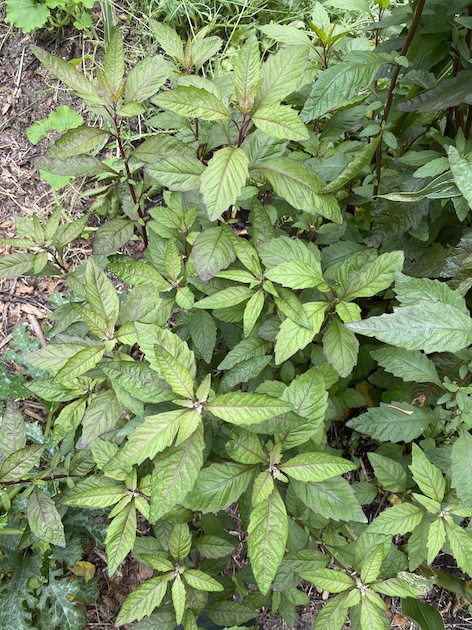
Plant is a hyperaccumulator of potentially toxic metals such as lead and zinc. This allows their use in bioremediatin projects but may render them unsafe for consumption on the affected soils.
Dysphania ambrosioides
Nomenclature
Latin NameDysphania ambrosioides
Common name in English and GermanEpazote, Mexican Tea
Regional namesPayqu (Quechua), Epazōtl (Nahuatl), Epazote (English/Spanish), Mexican tea (English), Jesuit's tea (English), Épazote (French), Thé du Mexique (French), Mexikanischer Tee (German), Wohlriechender Gänsefuß (German), Tè del Messico (Italian), Farinello aromatico (Italian), Paico (Spanish – South America), Hierba de Santa María (Spanish), Pasote (Spanish), Ambrósia-do-México (Portuguese), Erva-de-Santa-Maria (Portuguese), Mastruz (Portuguese – Brazil), Citronmålla (Swedish), Sitruunasavikka (Finnish), Ürt-hanemalts (Estonian), Komosa piżmowa (Polish), Merlík vonný (Czech), Mirhafű (Hungarian), Марь амброзиевидная [Mar' ambrozievidnaya] (Russian), Лобода амброзієвидна [Loboda ambroziyevydna] (Ukrainian), مخينزة [M'khinza] (Maghrebi Arabic), כַּף-אֲוָז רֵיחָנִית [Kaf-avaz reichanit] (Hebrew), 土荆芥 [Tǔ jīng jiè] (Chinese), ケアリタソウ [Ke-arita-sō] (Japanese), 양명아주 [Yang-myeongaju] (Korean), Dầu giun (Vietnamese)
Geographic data
Variety’s range of distributionMaingly Mexico and southeastern US, now naturalized in tropics and warm-temperate regions worldwide
Crop's center of diversityMesoamerica, North America
Provenance and collection data
CollectionMedicinal
Seed sourceSpore's partner, Spore garden
PartnerTlayolan
ProgrammeTlayolan
Cultivation
Life cycleAnnual
Winter hardyNo
Months suitable for planting seedsMay, June
Seed startingOutdoor
Days to harvest55
Growth habitHerb, Woody herb
Stem orientationUpright
Plant height (cm)60-120
Sun exposureFull sun
Water RequirementsRainfed
Soil preferenceHighly adaptable, Well drained
Successional communityPioneering, Wood edge, Patchy shrub-land
Potential use in agro-designHyperaccumulator of heavy metals such as lead (Pb) and zinc (Zn), rich in essential oils that can mask smell of other plants and have fungitoxic properties.
Reproduction
PollinationSelf pollinating
Reproductive biologyBisexual flower
Likelihood of hybridisationVery likely
Use
Consumable partsFruits & berries, Seeds, Leaves
Medicinal actionAnti-microbial, Anti-inflamatory, Vermifuge
Parts used medicinally and their effectMedicinal actions including antiparasitic, anti-inflammatory, and antimicrobial properties, with traditional uses for treating intestinal worms, indigestion, and respiratory issues. It also has antioxidant effects, and potential to aid in conditions like muscle spasms or anxiety. However, it is a toxic plant in high doses and should be used with caution, especially by pregnant women.
Gastronomic useCooked into dishes for its flavor and anti-gas effect