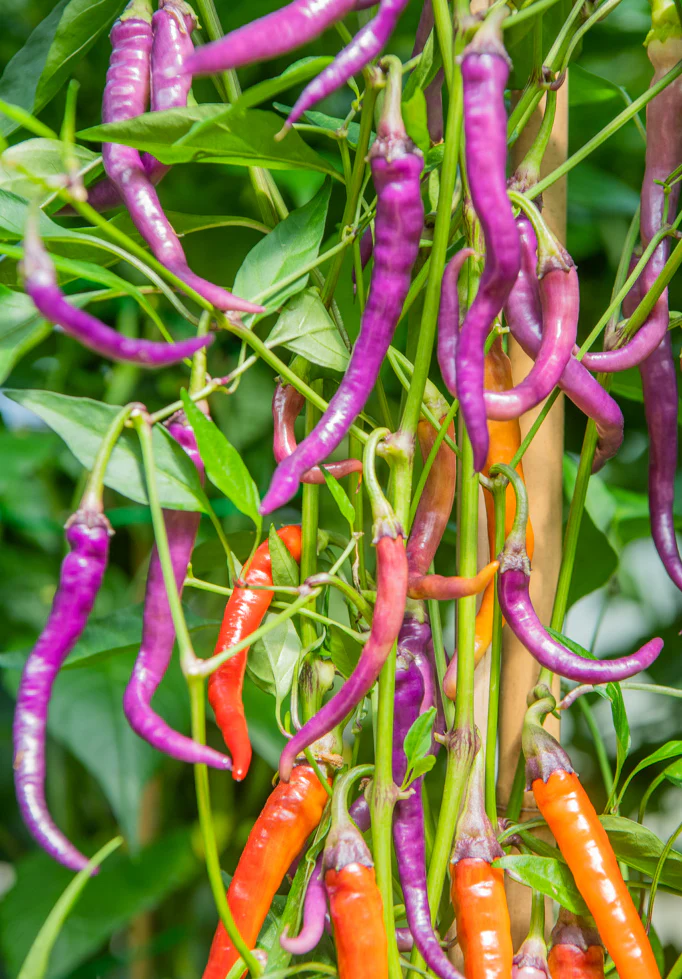
Attention to this variety originates from the seed collection of Horace Pippin (1888–1946), a Black folk artist from Pennsylvania, who traded and saved unusual pepper varieties. Pippin’s peppers were maintained by food historian William Woys Weaver and his family; Weaver’s grandfather received Buena Mulata from Pippin in 1944. The variety was later introduced to the public by Baker Creek Heirloom Seeds and is now part of seed collections focused on African diaspora heritage.
Capsicum annuum Pippin (Buena Mulata)
Nomenclature
Latin NameCapsicum annuum
VarietyPippin (Buena Mulata)
Common name in English and GermanChilli Buena Mulata
Regional namesCayenne pepper (English), Piment de Cayenne (French), Pepe di Caienna (Italian), Pimenta-caiena (Portuguese), Cayennepeper (Dutch), Cayennepeppar (Swedish), Cayennepippuri (Finnish), Papryka cayenne (Polish), Pepř kajenský (Czech), Cayenne-i paprika (Hungarian), Перец кайенский [Perets kayenskiy] (Russian), Перець каєнський [Perets kayens'kyy] (Ukrainian), Καγιέν [Kayién] (Greek), פלפל קאיין [Pilpel kayen] (Hebrew), فليفلة حريفة [Fulaifila harrifa] (Arabic), लाल मिर्च [Lal mirch] (Hindi), 卡宴辣椒 [Kǎyàn làjiāo] (Chinese), 카옌고추 [Kayengochu] (Korean), พริกเคเยน [Phrik khē-yen] (Thai)
Geographic data
Variety’s range of distributionNicaragua and worldwide
Crop's center of diversityMesoamerica
Provenance and collection data
CollectionKitchen garden
Seed sourceSpore's partner
PartnerAterraterra
ProgrammeAterraterra
Cultivation
Life cyclePerennial
Winter hardyNo
Months suitable for planting seedsFebruary, March
Seed startingIndoor
Days to harvest90
Growth habitSub shrub
Stem orientationUpright
Plant height (cm)100
Sun exposureFull sun
Water RequirementsRegular irrigation
Soil preferenceWell drained, Deep, Loam, Lower to neutral pH
Successional communityPioneering, Patchy shrub-land
Potential use in agro-designPotential to integrate into food landscapes in the areas where winter temperatures do not go lower than 12 °C. Chili powder has been used as a component of natural insecticides.
Reproduction
PollinationSelf pollinating
Reproductive biologyBisexual flower
Likelihood of hybridisationLess likely
Use
Consumable partsFruits & berries, Seeds
Medicinal actionTonic, Anti-inflamatory, Rubefacient
Parts used medicinally and their effectChili peppers contain capsaicin, which provides analgesic effects for arthritis and nerve pain by desensitizing receptors. They increase metabolism and fat oxidation, aiding weight management. High in Vitamin C and antioxidants, peppers support immune function and reduce inflammation. Consumption is linked to improved cardiovascular health and lower mortality rates. Research in 2025 also highlights their neuroprotective potential against Alzheimer’s.
Gastronomic usePippin (earlier known as Buena Mulata) is a chili with a hot cayenne‑level heat and a sweet‑smoky flavor when ripe. It can be chopped fresh into salsas, salads or stir‑fries, or dried and crushed into flakes or powder. It can be used for specialty “salsa morada” recipes because of its color and heat. At intermediate ripeness the flavor is mildly vegetal; at full red maturity the pods become fragrant and fruity. Some gardeners pickle or make hot sauces with these peppers; others dry whole pods to flavor soups, stews or chili. Overall its uses include fresh salsa, stir-fries, sauces, dried flakes, and oils – any context where a cayenne pepper would be used but with extra color and sweetness.