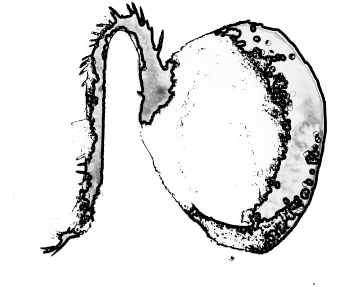
Plantago major
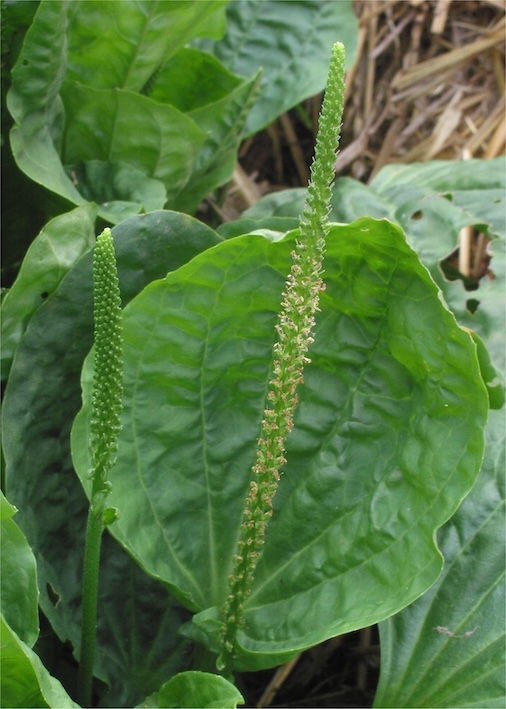
Nomenclature
Latin NamePlantago major
Common name in English and GermanBroadleaf plantain, Breitwegerich
Regional namesGrand plantain (French), Plantain majeur (French), Breitwegerich (German), Großer Wegerich (German), Llantén (Spanish), Llantén mayor (Spanish), Tanchagem-maior (Portuguese), Erva-das-sete-linhas (Portuguese), Piantaggine maggiore (Italian), Petacciola (Italian), Grote weegbree (Dutch), Groblad (Swedish/Norwegian/Danish), Babka zwyczajna (Polish), Подорожник большой [Podorozhnik bol'shoy] (Russian), Голям живовлек [Golyam zhivovlek] (Bulgarian), Jitrocel větší (Czech), Nagy útifű (Hungarian), לֶחֶךְ גָּדוֹל [Lechech gadot] (Hebrew), 大车前 [Dà chē qián] (Chinese), オニオオバコ [Onioobako] (Japanese), 왕질경이 [Wang jil gyeong i] (Korean), जंगली ईसबगोल [Jangli isabgol] (Hindi), लहुरिया [Lahuriya] (Hindi), चमचे झार [Chamche jhar] (Nepali), सಿರಪೊಟ್ಲ ಗಿಡ [Sirapotla gida] (Kannada), இசப்புக்கோல் விதை [Ishappukol vitai] (Tamil), ཐ་རམ [Tha-ram] (Tibetan), Daun Sendok (Indonesian), ผักกาดน้ำ [Phak kat nam] (Thai), Mã đề (Vietnamese), بارهنگ [Barhang] (Persian), لسان الحمل [Lisan Al-hamal] (Arabic), Kopakopa (Māori), Laukahi (Hawaiian), Filo (Tongan), Lanting (Tagalog/Filipino), Saqarara (Quechua)
Geographic data
Variety’s range of distributionGlobally
Crop's center of diversityMediterranean, Central Asia, Europe
Provenance and collection data
CollectionMedicinal
Seed sourceSpore garden
Cultivation
Life cyclePerennial
Winter hardyYes
Months suitable for planting seedsMarch, April, May, September, October
Seed startingOutdoor
Days to harvest120
Growth habitHerb
Stem orientationUpright
Use as ground coverRosette
Plant height (cm)30
Sun exposureFull sun, Partial shade
Water RequirementsModerate water demand
Soil preferenceHighly adaptable
Successional communityPioneering, Grassland, Patchy shrub-land
Potential use in agro-designAccumulates Zn and Pb from the soil, strong fibrous root system, can be included in soil-remediation projects.
Reproduction
PollinationCross pollinating
Reproductive biologyMonoecious
Likelihood of hybridisationPossible
Use
Consumable partsSeeds, Leaves
Medicinal actionExpectorant, Anti-microbial, Anti-inflamatory, Vulnerary
Parts used medicinally and their effectPlantago major contains bioactive compounds including aucubin, ursolic acid, and polyphenols. It is used for wound healing, including burns and ulcers, by stimulating fibroblast proliferation. Its has anti-inflammatory properties and can assist treatment of dermatitis. Antimicrobial effects have been observed.
In the gastrointestinal system mucilage and fiber of the seeds act as a laxative and assist in managing gastritis. Leaves extract serves as an expectorant for respiratory conditions such as bronchitis. Metabolic effects, including lowering blood glucose and protecting liver function by reducing enzymatic activity, are currently investigated.
Gastronomic useYoung leaves can be consumed raw. Their taste reminds of mushrooms but can be very bitter.