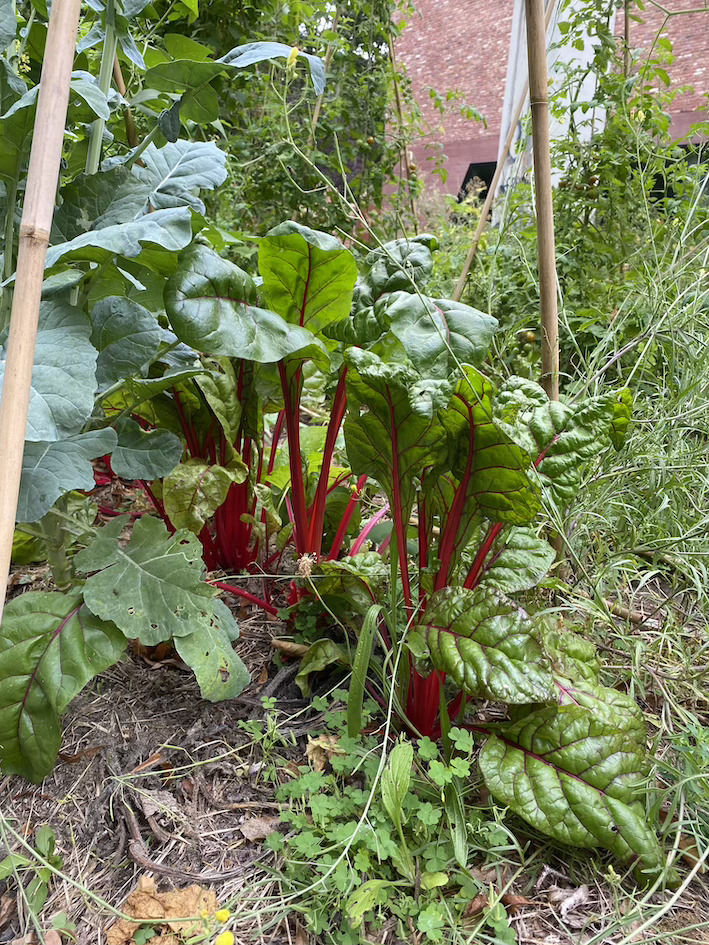
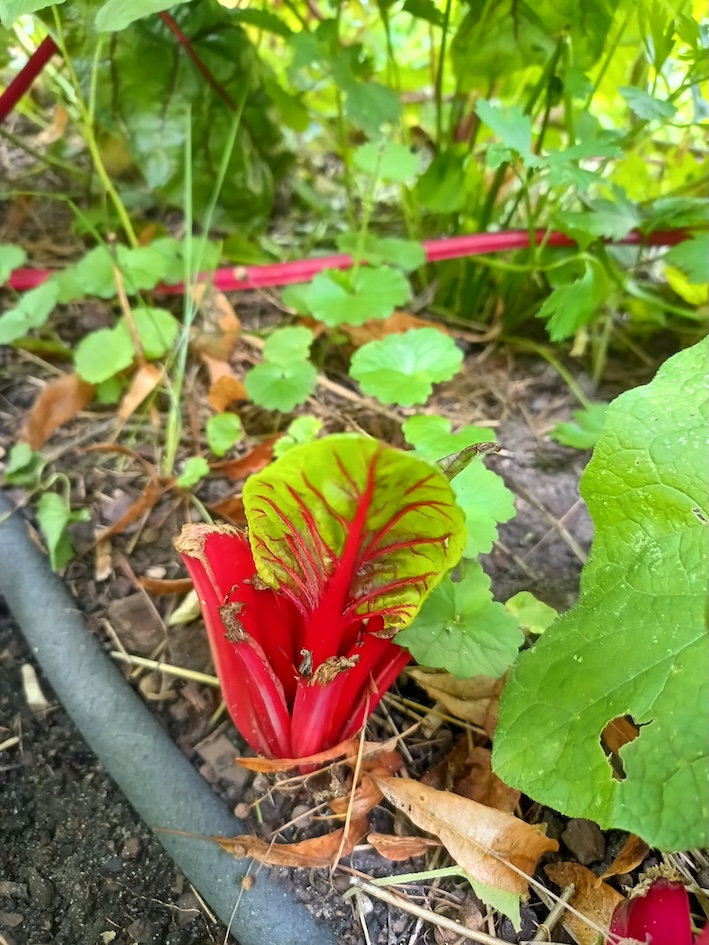
Blooms in the second year and needs to be isolated from other beets in order to stay true to type.
Beta vulgaris subsp. Rhubarb Chard
Nomenclature
Latin NameBeta vulgaris subsp.
VarietyRhubarb Chard
Common name in English and GermanChard, Mangold
Regional namesSwiss chard (English), Silverbeet (English – New Zealand/Australia), Mangold (English/German), Perpetual spinach (English), Seakale beet (English), Leaf beet (English), Acelga (Spanish/Portuguese), Bette (French), Blette (French), Poivrée (French – regional), Jotte (French – regional), Bietola (Italian), Bieta (Italian), Snijbiet (Dutch), Witlof (Dutch – regional), Sesserli (Swiss German), Krautstiel (Swiss German), Chrutstile (Swiss German), Chard (English), Schweizer mangold (Swedish), Bladbede (Danish), Skovmælde (Danish), Boćwina (Polish), Mangold (Romanian), Pazı (Turkish), Σέσκουλο [Séskoulo] (Greek), מַנְגוֹלְד [Mangold] (Hebrew), סֶלֶק עָלִים [Selek alim] (Hebrew), سِلْق [Silq] (Arabic), چغندر سوئیسی [Choghondar-e su'isi] (Persian), 瑞士甜菜 [Ruìshì tiáncài] (Chinese), スイスチャード [Suisu chādo] (Japanese), 근대 [Geundae] (Korean), स्विस चार्ड [Swiss chard] (Hindi)), ผักกาดสวิส [Phak kat sawit] (Thai), Cải cầu vồng (Vietnamese), Σέσκουλο [séssklo] (Greece), Pazı (Turkish)
Geographic data
Variety’s range of distributionWestern Europe
Crop's center of diversityMediterranean
Provenance and collection data
CollectionKitchen garden
Seed sourceCommercial supplier, Spore garden
Cultivation
Life cycleBiannual
Winter hardyYes
Months suitable for planting seedsApril, May, June, July
Seed startingOutdoor
Days to harvest55
Growth habitHerb
Stem orientationUpright
Plant height (cm)40
Sun exposureFull sun, Partial shade
Water RequirementsModerate water demand
Soil preferenceWell drained, Loam, Neutral to higher pH
Potential use in agro-designThis chard variety is winter hardy down to -7C° and can be harvested throughout the season and in the following spring.
As a shade tolerant specie it can be grown under the trellis of runner beans to optimize use of space.
Reproduction
PollinationCross pollinating
Reproductive biologyDioecious
Likelihood of hybridisationVery likely
Use
Consumable partsLeaves, Stalks
Gastronomic useThis variety of chard tastes good both raw in salads and cooked in soups, stews and sauces. Stalks of the leaves are tender and not fibrous.