
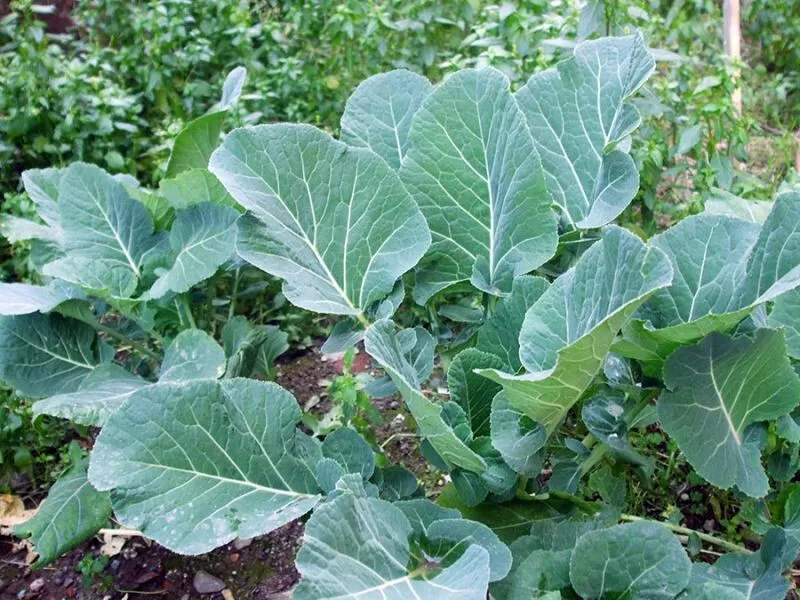
It is a biannual plant which blossoms in the second season of its growth, requiring isolation from other brassicas to preserve its type.
Brassica oleracea var. acephala Karalahana
Nomenclature
Latin NameBrassica oleracea var. acephala
VarietyKaralahana
Common name in English and GermanKale, Blattkohl
Regional namesKaralahana (Turkish), Black Sea cabbage (English), Flat leaf kale (English), Chou kale (French), Grünkohl (German), Cavolo nero (Italian), Col rizada (Spanish), Couve (Portuguese), Boerenkool (Dutch), Λαχανίδα [Lachanída] (Greek), Кудрявая капуста [Kudryavaya kapusta] (Russian), Jarmuż (Polish), Kelkáposzta (Hungarian), Lehtikaali (Finnish), Grönkål (Swedish), 羽衣甘蓝 [Yǔyī gānlán] (Chinese), ملفوف أسود [Malfuf aswad] (Arabic), Sukuma wiki (Swahili), Cải xoăn (Vietnamese)
Geographic data
Variety’s range of distributionBlack Sea coast of Türkiye
Crop's center of diversityMediterranean
Provenance and collection data
CollectionKitchen garden
Seed sourceSpore's partner
PartnerAterraterra
ProgrammeAterraterra
Cultivation
Life cycleBiannual
Winter hardyYes
Months suitable for planting seedsApril, May
Seed startingIndoor
Days to harvest65
Growth habitHerb
Stem orientationDecumbent, Upright
Plant height (cm)60
Sun exposureFull sun, Partial shade
Water RequirementsModerate water demand
Soil preferenceHighly adaptable, Neutral to higher pH
Potential use in agro-designThis kale variety is winter hardy down to -7C° and can be harvested in the following spring.
As a shade tolerant specie it can be grown under the trellis of runner beans to optimize use of space.
Reproduction
PollinationCross pollinating
Reproductive biologyBisexual flower
Likelihood of hybridisationVery likely
Use
Consumable partsBuds, Leaves
Gastronomic useIt is traditionally used for stews, soups (like karalahana çorbası), and stuffed dolma-like dishes (like karalahana sarması).