Symbolism: Connected with magic and protection in European folklore, regarded as a bitter herb for purification.
Etymology: Marrubium from Hebrew ‘marrob’ meaning bitter juice.
Traditional ecological knowledge: Employed in old remedies for cough and digestion, key ingredient in medieval candy and herbal wine, well-known for growing in dry, waste places.
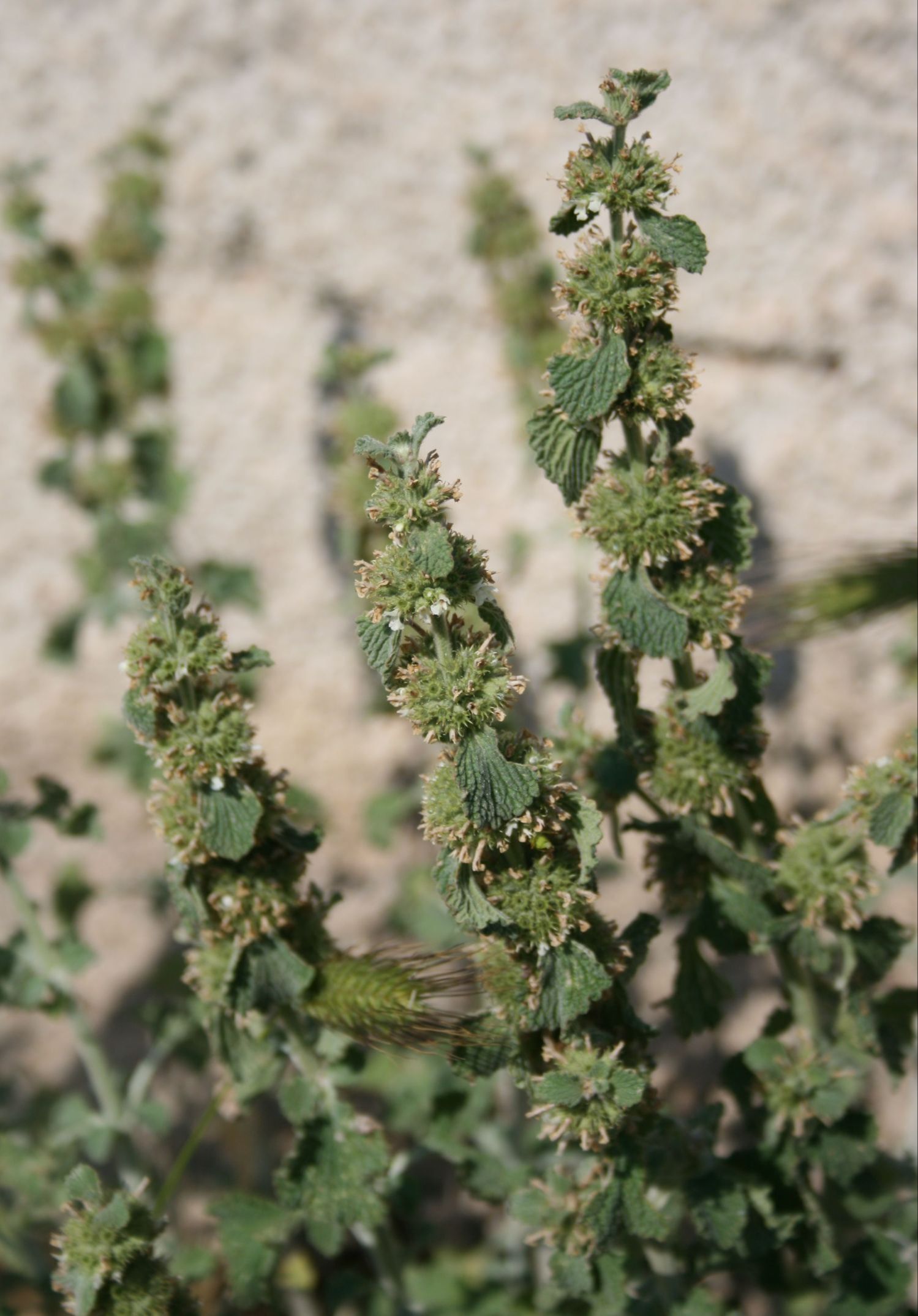
Marrubium vulgare
Nomenclature
Latin NameMarrubium vulgare
Common name in English and GermanWhite Horehound, Maurerandorn
Regional namesWhite horehound (English), Common horehound (English), Hoarhound (English), Houndsbane (English), Marrube blanc (French), Marrube (French), Gewöhnlicher Andorn (German), Weißer Andorn (German), Mauerandron (German), Marrubio (Spanish), Marrubio comune (Italian), Erba apiola (Italian),Mal robbio (Italian), Marroio (Portuguese), Erva-virgem (Portuguese), Herba dos lombos (Portuguese), Malrove (Dutch), Ürt-penimünt (Estonian), Valkohurtanminttu (Finnish), Kransborre (Swedish), Borremynte (Norwegian), Szanta zwyczajna (Polish), Jablečník obecný (Czech), Jablčník obyčajný (Slovak), Orvosi pemetefű (Hungarian), Unguraș (Romanian), Шандра обыкновенная [Shandra obyknovennaya] (Russian), Шандра звичайна [Shandra zvychayna] (Ukrainian), Очајница [Očajnica] (Serbian/Bosnian/Croatian – meaning "desperate woman"), Бели тетрљан [Beli tetrljan] (Serbian), Пчелинок [Pchelinok] (Macedonian), Μαρρούβιο το κοινό [Marrouvio to koino] (Greek), Πράσιον [Prasion] (Ancient Greek), فراسيون شائع [Farasiyun sha'i] (Arabic), حشيشة الكلب [Hashishat al-kalb] (Arabic), گندنای کوهی [Gandna-ye kuhi] (Persian), Karaderme (?) (Turkish), 欧夏至草 [Ōu xiàzhì cǎo] (Chinese)
Geographic data
Variety’s range of distributionEurope, Northern Africa, Southwestern/Central Asia, widely naturalized
Crop's center of diversityMediterranean, Central Asia
Provenance and collection data
CollectionMedicinal
Seed sourceCommercial supplier
Cultivation
Life cyclePerennial
Winter hardyYes
Months suitable for planting seedsMarch, April
Seed startingOutdoor
Days to harvest75
Growth habitHerb
Stem orientationAscending, Upright
Plant height (cm)20-100
Sun exposureFull sun
Water RequirementsDrought resistant
Soil preferenceWell drained, Sandy, Rocky, Neutral to higher pH
Successional communityPioneering, Patchy shrub-land
Potential use in agro-designSuitable for poor soils, drought tolerant
Reproduction
PollinationCross pollinating
Reproductive biologyBisexual flower
Likelihood of hybridisationLess likely
Use
Consumable partsFlowers, Leaves
Medicinal actionExpectorant, Anti-microbial, Anti-spasmodic, Tonic
Parts used medicinally and their effectFlowers harvested when flowering begins, used in bitter tonics or tees
Gastronomic useLozenges, tees, or historically for herbal beers. Tastes bitter