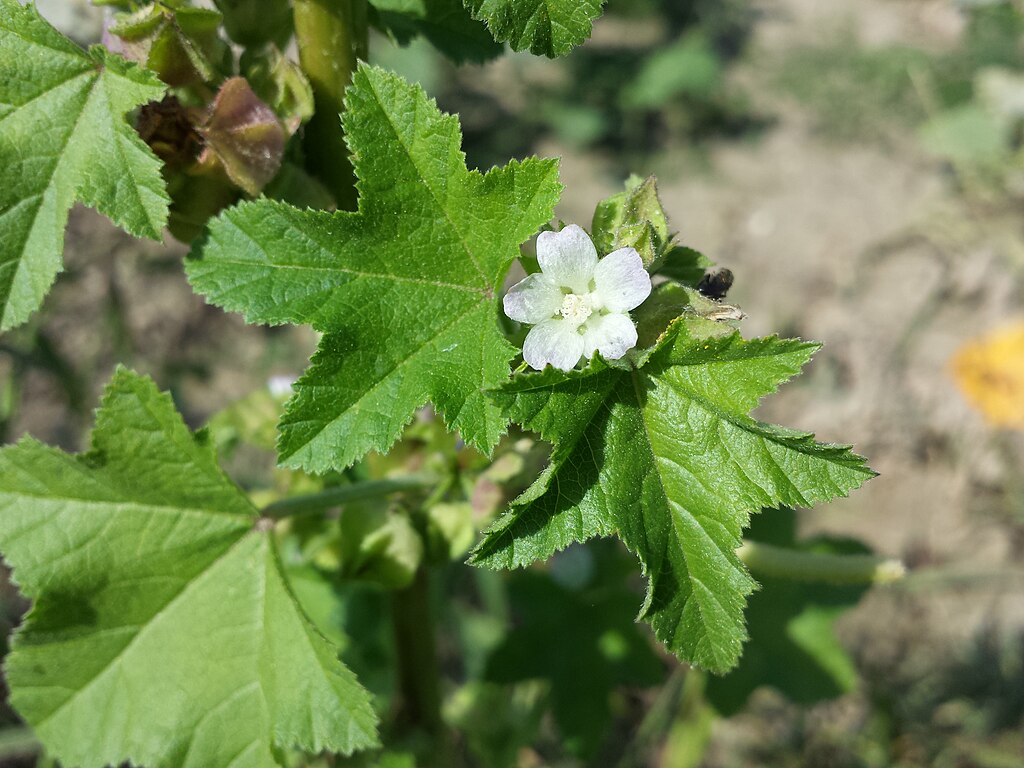
When grown on nitrogen rich soils (and particularly when these are cultivated inorganically), the plant tends to concentrate high levels of nitrates in its leaves. The leaves are perfectly wholesome at all other times.
Malva verticillata Chinese mallow
Nomenclature
Latin NameMalva verticillata
VarietyChinese mallow
Common name in English and GermanChinese mallow, Quirl-Malve
Regional namesChinese mallow (English), Cluster mallow (English), Whorled mallow (English), Curled mallow (English), Mauve verticillée (French), Mauve crépue (French), Mauve chinoise (French), Quirl-Malve (German), Krause Malve (German), Gemüse-Malve (German), Malva crespa (Italian/Spanish), Malva-crespa-verdadeira (Portuguese), Kranskaasjeskruid (Dutch), Dessertbladen (Dutch), Kransmalva (Swedish), Kranskattost (Norwegian), Kransblomstret katost (Danish), Kiehkuramalva (Finnish), Männasjas kassinaeris (Estonian), Ślaz kędzierzawy (Polish), Sléz přeslenitý (Czech), Slez kučeravý (Slovak), Takarmánymályva (Hungarian), Ядлив слез [Yadliv slez] (Bulgarian), Мальва мутовчатая [Mal'va mutovchataya] (Russian), Просвирник мутовчатый [Prosvirnik mutovchatyy] (Russian), Калачики кільчасті [Kalachyky kil'chasti] (Ukrainian), خبازة مجدولة [Khubaza majduwla] (Arabic), خبازه مجدوله [Khubaza majduwla] (Egyptian Arabic), 野葵 [Yě kuí] (Chinese), 아욱 [A-uk] (Korean), सोचल [Soachal] (Kashmiri/Hindi)
Geographic data
Variety’s range of distributionFrom North-east Africa across temperate Asia to north Myanmar
Crop's center of diversityEast Asia (China+), South Asia (India+)
Provenance and collection data
CollectionHardy annuals and bi-annuals
Seed sourceCommercial supplier, Spore garden
Cultivation
Life cycleAnnual
Winter hardyNo
Months suitable for planting seedsMarch, April, May, June, July, August
Seed startingOutdoor
Days to harvest60
Growth habitHerb
Stem orientationUpright
Use as ground coverDensely covers soil
Plant height (cm)120
Sun exposureFull sun
Water RequirementsModerate water demand
Soil preferenceHighly adaptable, Loam
Successional communityPioneering, Grassland, Patchy shrub-land
Potential use in agro-designIt is a nitrophilous plant and absorbs excess nitrogen from the soil. This makes it a buffer crop at the edges of fields to prevent nutrient runoff. It has a deep taproot, therefor can be used in remediating compacted soil. Also can be used as a trap crop on the edge of the row crop sites.
Can fill gaps in early succession parts of the edible landscapes designs.
Reproduction
PollinationSelf pollinating
Reproductive biologyDioecious
Likelihood of hybridisationVery likely
Use
Consumable partsLeaves
Medicinal actionDiuretic, Laxative
Parts used medicinally and their effectMalva verticillata is a nutrient-dense herb. Its leaves are rich in mucilage, serving as a gentle digestive laxative and a diuretic (also seeds) to reduce water retention and support kidney function. It is recognized for helping to lower blood sugar via improved glucose uptake.
Gastronomic useChinese Mallow is a versatile leafy vegetable prized for its mild, spinach-like flavor and high concentrations of vitamins A and C (when consumed raw).
Leafy Greens: The young leaves are the primary edible part. They are commonly stir-fried, sautéed with garlic, or added to soups, where their natural mucilage acts as a healthy, silky thickener.
Korean Staples: In Korea, the leaves are essential for Auk-guk (soybean paste soup) and nutritious rice porridges.
Edible Seeds: The small, disc-shaped green seeds have a mild, nutty flavor and can be eaten raw as a snack or tossed into salads.
Innovative Substitutes: The roots can be boiled to create a liquid that, when whisked, serves as a plant-based alternative to egg whites.
For best texture, younger leaves (under 15 cm) are best for raw salads and light sautés, while older leaves are better suited for slow-simmered stews and broths. Because it is a "cut-and-come-again" crop, it provides a consistent harvest of fresh greens throughout the growing season.