
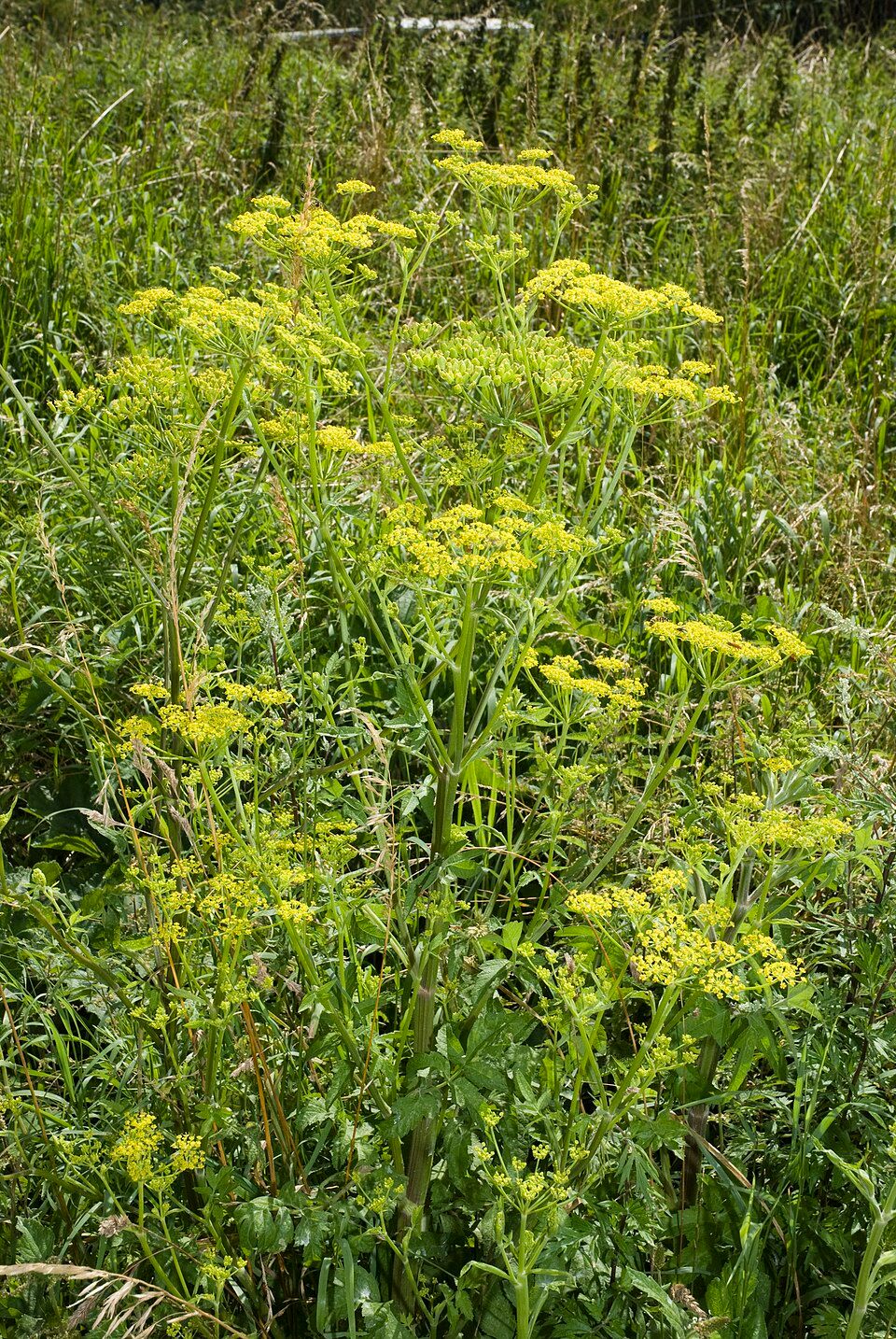
WARNING: The sap of both wild and cultivated parsnips contains furanocoumarins, which cause phytophotodermatitis—a severe chemical burn that occurs when the sap on the skin is exposed to UV sunlight. Proofed by personal experience.
Etymology: From Latin ‘pastus’ (food) and ‘sativa’ (cultivated). Name suggests staple root food.
Traditional ecological knowledge: Used in ritual foods in Northern Europe and Britain, wild parsnip linked to fertility of the soil and staple diet before the rise of potatoes.
Pastinaca sativa Wild pastinak
Nomenclature
Latin NamePastinaca sativa
VarietyWild pastinak
Common name in English and GermanParsnip, Pastinake
Regional namesParsnip (English), Pastinaca (Italian), Panais (French), Pastinake (German), Pastinak (Danish), Pastinakk (Norwegian), Palsternacka (Swedish), Pastinaak (Dutch), Pasternak (Polish), Пастернак [Pasternak] (Russian/Ukrainian), Παστινάκη [Pastináki] (Greek), Υποκαρδάμο [Ypokardamo] (Greek), Yaban havucu (Turkish), جزر أبيض [Jazar abyad] (Arabic), شقاقل [Shaqaqul] (Arabic/Persian), 欧洲防风 [Ōuzhōu fángfēng] (Chinese), パースニップ [Pāsunippu] (Japanese), Pasternaks (Latvian), Pastarnokas (Lithuanian), Păstârnac (Romanian)
Geographic data
Variety’s range of distributionOriginally Europe, Caucasus, Western Asia, nowadays naturalized in North America and West Asia
Crop's center of diversityCentral Asia, Europe, Caucasus
Provenance and collection data
CollectionHardy annuals and bi-annuals
Seed sourceSpore garden
Cultivation
Life cycleBiannual
Winter hardyYes
Cold stratificationyes
Months suitable for planting seedsMarch, April, October, November
Seed startingOutdoor
Days to harvest300
Growth habitHerb
Stem orientationUpright
Plant height (cm)150
Sun exposureFull sun
Water RequirementsRainfed
Soil preferenceHighly adaptable, Well drained, Neutral to higher pH
Successional communityPioneering, Grassland
Potential use in agro-designIt is a good admixture in the regenerative meadow seed mixtures. Its taproot has the capacity to loosen the soil. Flowers of the second year provide food to a wide range of insects such as bees, parasitic wasps, butterflies. Root is edible when harvested in the winter of its first year of life.
Reproduction
PollinationCross pollinating
Reproductive biologyBisexual flower
Likelihood of hybridisationVery likely
Use
Consumable partsRoots
Gastronomic useWhen harvested in early winter of its first year of life roots are sweet and nutty with agreeable texture.